


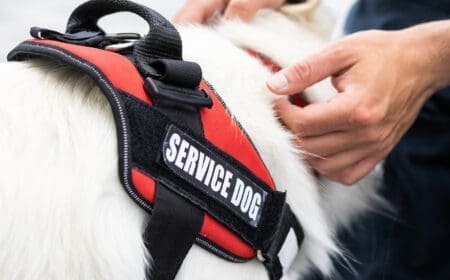

Whether registration is required is one of the most common questions people ask after training a service dog or realizing they may qualify for one.
You may have seen websites offering instant service dog registration, ID cards, certificates, or online databases that promise to make your dog “official.” You may also have heard some people say that registration is a scam and completely useless.
So, what’s the truth? Is registering a service dog required by law? Let’s find out.
Registering a Service Dog: Is It a Legal Requirement?
No, you don’t have to register a service dog in the U.S. No federal or state law requires service dogs to be registered, certified, or listed in a database. This applies to all types of service dogs.
Under the Americans with Disabilities Act (ADA), a service dog is legally recognized based on their training and purpose. In other words, a dog is considered a service dog if you individually train them to perform tasks that directly help with your disability.
The ADA doesn’t require service dogs to wear a vest or carry an ID card, either. There’s no official government registry for service dogs. If your dog meets the ADA definition, they’re legally a service dog, even if you never register them anywhere.
What Makes a Dog a Legitimate Service Dog?
Your service dog should meet three core standards under U.S. law.
1. You Have a Qualifying Disability
You should have a physical, psychiatric, sensory, or medical disability that substantially limits one or more major life activities. The disability doesn’t have to be visible, and you don’t have to explain medical details to the public.
2. The Dog Is Task-Trained
Your dog has to be trained to perform specific tasks that help manage your disability. These tasks go beyond emotional comfort or companionship.
For example, a service dog can be trained to guide a blind person, alert someone before a seizure or changes in blood sugar levels, retrieve items for someone with mobility limitations, provide balance support while walking, or interrupt panic attacks by applying pressure or redirecting attention.
3. Your Dog Must Be Calm and Well-Behaved in Public
Your dog should behave appropriately in public spaces at all times. This includes being housebroken, remaining under control, and not acting disruptively.
Even a fully trained service dog can legally be asked to leave a location if they’re barking continuously, being aggressive, relieving themselves indoors, or threatening the safety of others. Training and behavior matter just as much as task work.
Why Do So Many People Still Get Their Service Dogs Registered?
Voluntary registration is purely out of convenience. Many service dog handlers face endless questions, judgmental stares, or access challenges when entering public places. Employees may not know ADA rules, and strangers may assume the dog is a pet.
Having something visible, like a vest, ID card, or registration certificate, can reduce how often a handler has to answer repeated questions, deal with public confrontations, or defend their rights. The staff can also recognize the dog as working at a glance, so there’s less back-and-forth at the door.
In addition, when a service dog is wearing a vest or ID card, it may discourage strangers from petting or questioning the handler. For many people, this reduces anxiety and helps maintain boundaries in public spaces.
Having identification tools also helps when dealing with landlords. Even though registration isn’t legally required, some landlords are unfamiliar with service dog and assistance animal rules. A visible ID or paperwork can prevent unnecessary delays during the rental process and reduce the need for repeated explanations about why the dog is allowed under fair housing laws.
All in all, service dog registration helps reduce stress, save energy, and avoid repeated misunderstandings. When you’re already managing a disability, you don’t want to deal with extra stress everywhere you go.
Questions Businesses Are Allowed to Ask
Under the ADA, businesses can ask only two questions about a service dog:
- Is this a service dog required because of a disability?
- What work or task has the dog been trained to perform?
They’re not allowed to ask for medical documentation, proof of disability, registration papers, or training certificates. They also can’t require the dog to demonstrate any learned tasks.
Despite this, many employees aren’t adequately trained in service animal laws, which leads to confusion and misunderstandings. There are also some cases where businesses have to deal with fake service dogs brought in by people who misuse the label. These regular pets aren’t trained for public settings.
When those dogs bark, jump on people, or cause disruptions, it creates confusion for staff. This leads to more questioning of real service dogs. This is one reason many handlers choose to use visual identifiers, even though they’re not required by law.
Is Online Service Dog Registration Legit?
Online service dog registration is legal in the sense that private companies are allowed to offer these services. However, these registrations are not official, government-issued, or legally required. Plus, they don’t give a dog the legal status of a service dog.
These services usually provide ID cards, certificates, digital profiles, or service dog vests. These items can be helpful as visual cues, but they don’t give any legal rights.
The ADA doesn’t recognize or endorse any registration company. This means registration should never be mistaken for legal validation.
Warning Signs of Misleading Registration Claims
The confusion around service dog registration has led many online platforms to take advantage of people who are simply trying to follow the rules. Some websites claim their registration service is approved by the government, but that’s not true. Phrases like “federal registration,” “ADA-certified,” or “government approved” are major red flags.
Some sites try to make it seem like paperwork is what makes a service dog “official.” They create a sense of urgency by claiming registration is required to avoid access issues or legal problems. This is misleading. Under the law, what matters most is the dog’s training and the tasks it performs to assist with a disability.
Apart from this, you should be cautious of platforms that downplay training or avoid discussing service tasks altogether. A real service dog is trained over time, not approved instantly through an online form. No matter how official these company-provided documents look, they don’t grant legal rights.
Registering a Service Dog: Step-By-Step Process
Here are four steps to register your service dog in the U.S.:
Step 1: Obtain a Note From a Licensed Mental Health Practitioner (Optional but Recommended)
Although a note from a licensed mental health practitioner isn’t required to have a service dog under the ADA, some people still choose to get one for their own records. This is especially common for handlers with psychiatric or mental health disabilities, such as anxiety disorders, PTSD, or depression.
A legitimate note should come from a licensed professional who’s actively treating you, such as a psychologist, psychiatrist, licensed clinical social worker, or therapist. It should generally state that you have a disability and that a service dog helps you manage symptoms through trained tasks.
That said, keep in mind that legitimate services don’t require medical paperwork to sell optional identification tools.
Step 2: Search for Registration Options
When you search for service dog registration online, you’ll see many websites claiming to offer fast or easy solutions. Instead of clicking the first result, take time to compare multiple sites. Look for consistency in how they explain service dog laws.
If one site says registration is required and another says it’s optional, go for the latter. Legitimate registration platforms usually include a disclaimer explaining that their service isn’t government-affiliated. This information is often found in the FAQ or the website footer.
If a site hides this information or avoids legal explanations altogether, it may be intentionally vague. Transparency is a good sign that the company isn’t trying to mislead users.
Step 3: Understand Exactly What You’re Paying For
Before entering payment information, make sure you understand what the service actually provides. Most legitimate platforms sell physical items like ID cards, vests, or digital profiles for convenience. They don’t promise guaranteed access or legal protection.
Step 4: Provide Accurate Information About Your Dog
Make sure you provide accurate information about your dog. Most legitimate platforms ask for basic details such as your dog’s name, breed or mix, color, size, and sometimes a photo. This information is used only to create ID cards, profiles, or vests that visually identify your dog as a working dog.
Providing accurate details means the identification tools can actually serve their purpose. If your dog goes missing, is separated from you, or is questioned by staff, having matching information can help avoid confusion.
Local Licensing and Vaccination Still Matter
Even though service dogs have special protections under federal law, they’re still subject to basic local animal rules. Most cities and counties require all dogs, including service dogs, to be licensed and up to date on vaccinations. These rules are meant to protect public health and safety.
Local licensing usually involves registering your dog with the city or county and showing proof of vaccinations, especially rabies. In many areas, service dog handlers are offered reduced fees or exemptions, but the licensing process itself still applies.
Keeping this information current can help avoid issues if animal control ever gets involved or if your dog is lost and needs to be identified.
Vaccinations are especially important for service dogs because they spend a lot of time in public spaces. Proper vaccination protects the dog, the handler, and those around them. While licensing and vaccination don’t affect your dog’s status as a service dog under the ADA, staying compliant with local rules will help prevent unnecessary problems.

Registering a Service Dog Is Simple, but Requires Careful Research
Deciding whether to register your service dog is a personal choice. Some handlers find it helpful, while others never use it. What really matters is that your dog is well-trained, well-behaved, and able to perform tasks that support your disability.
If registration tools make your life easier, they can be worth considering. If not, you’re still fully protected under the law without them. If you do decide to get your service dog registered, make sure you find a legitimate website that explains that registration is optional, doesn’t create legal rights, and doesn’t replace proper training.