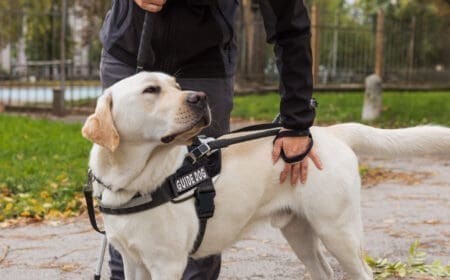


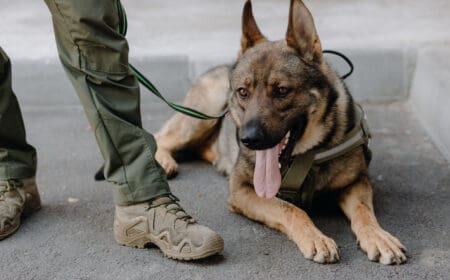

Psychiatric service dogs (PSDs) are among the most specialized, highly skilled service animals. These dogs are trained to perform specific tasks that are directly related to one or more mental disabilities, such as anxiety, post-traumatic stress disorder, dissociative disorders, attention-deficit hyperactivity disorder, and many others.
Unlike emotional support animals, which also have certain legal rights, psychiatric service dogs are recognized as service animals. They have certain public access rights per the Americans with Disabilities Act (ADA), meaning they can legally accompany their handlers in public spaces to carry out their trained duties.
However, there’s a clear line between emotional support and performing a disability-related task. While many dogs have the ability to stay close to their owners and provide solace, psychiatric service dogs must undergo training to be able to assist their handlers. In this article, we will cover everything you need to know about this critical process. Read on as we cover all you need to know about psychiatric service dog training.
Psychiatric Service Dog Training: How Is It Different From Others?
Given that psychiatric service dogs are highly specialized service animals, training these dogs has some unique aspects. Their training focuses more on behavioral and emotional cues rather than purely physical tasks that benefit the handler. A psychiatric service dog sees their handler engaging in a specific behavior and responds in unique ways related to their disability.
For example, a psychiatric service dog can be trained to recognize changes in breathing, a common indicator of an impending panic attack, and begin deep pressure therapy to help mitigate or even prevent the episode. Compared to a more physical service dog task, such as bracing, where the dog tenses their body to provide a stable counterforce upon the handler giving the command, most psychiatric service dog tasks are done following a recognition and response, where the dog identifies a cue and immediately performs a trained action.
Due to the difference in the nature of the tasks involved, psychiatric service dog training emphasizes constant engagement and awareness. It is essential to help dogs undergoing PSD training to associate specific tasks with specific behaviors. Naturally, people-oriented dog breeds, such as the golden retriever and cavalier King Charles spaniel, are the most well suited dog breeds for psychiatric service dog training.
Is It Possible to Train Your Own Service Dog?
Yes, it is possible to train your own PSD, and, in fact, it is a popular route that many handlers take. The Americans with Disabilities Act doesn’t require service animals to be professionally trained. Any well behaved dog that can perform a disability-related task qualifies to be a service dog.
The most attractive aspect of self-training is the affordability. A fully trained service dog can cost upwards of $30,000, whereas training your own costs only a few hundred dollars. It is also much more affordable than hiring a professional dog trainer to train your dog for service dog work, which can cost up to $300 per session. All things considered, self-training is often the most affordable route.
However, training your own service dog requires a significant investment of your time and effort. You must dedicate yourself to learning about dog behavior, training, and psychology to achieve success. Consistency and routine are also critical in service dog training. They are learning to do a job that’s always on 24 hours a day, 7 days a week, and therefore, training must be a daily event in order to reflect that.
You can always consult a professional dog trainer for guidance, especially if you come across challenges that you can’t seem to get over, such as teaching something specific or working around your dog’s instincts to prevent them from losing focus. This hybrid approach can ensure your dog develops proper skills and avoids common mistakes handlers make while training their own service dogs.
How to Start Psychiatric Service Dog Training?
Psychiatric service dog training begins with preparation and understanding that consistency and routine are two of the most critical components. If you’re unable to commit at the moment, it is best to hold off on psychiatric service dog training rather than training your dog for inconsistent periods.
Once you’re ready to commit yourself, here’s how you can start psychiatric service dog training.
Identify Your Dog’s Suitability
First and foremost, identify your dog’s suitability for psychiatric service dog training. Your dog must have the right temperament for service dog work. They should be calm, confident, focused, and eager to learn, without showing any signs of aggression or extreme fear in new environments or in the presence of unfamiliar people. This initial evaluation is important for setting realistic expectations.
It is also important to consider your dog’s suitability not just for general psychiatric service dog training but also for the specific tasks you require. For example, if you want to have your dog provide deep pressure therapy during heightened levels of anxiety, but you have a Chihuahua, you might need to consider getting a bigger dog for that task.
Basic Obedience and Socialization
Before moving into task training, your dog must have a solid foundation in basic obedience. Your dog should know all the basic commands and skills like sit, stay, recall, and leash manners. If your dog needs touching up on these, it is best to get them out of the way before beginning task training, as a lack of basic obedience can create problems down the line.
Socialization is equally important, as your dog needs to be comfortable around people, other animals, and different environments. A dog that doesn’t feel confident in their surroundings will lose focus quickly, which can make them abandon their duties. Be sure that your dog is well-socialized and exposed to a wide range of environments, this will help them succeed in psychiatric service dog work.
Disability-Related Task Training
Once the basics are out of the way, you can begin training your dog for tasks that directly assist you with your disability, whether that’s grounding work, behavior interruption, prompting you to routines, or alerting to specific cues. During this critical part of training, start in low-distraction environments like your home or backyard and gradually expand into real-world settings to simulate everyday scenarios.
That’s where practice plays a critical role in ensuring you have a reliable psychiatric service dog. Simulate real-life situations day after day until your dog doesn’t require a big motivator like a treat or playtime to execute what they’ve learned throughout their psychiatric service dog training.
Psychiatric Service Dog Training FAQs
Below are our answers to commonly asked questions about psychiatric service dog training.
How Long Does Psychiatric Service Dog Training Take?
Since every handler has unique needs and every dog has their own personality traits and trainability, it is difficult to give an exact timeframe for how long psychiatric service dog training takes. However, on average you can expect your dog to have a solid foundation of obedience and socialization after three to five months, with task training for each task taking another three to five months to complete.
Can a Landlord Reject a Psychiatric Service Dog?
A landlord cannot reject a psychiatric service dog because of no-pet policies. This includes instances where the tenant gets a psychiatric service dog after signing their lease or rental agreement, whether it includes a no-pet clause or not. Doing so would be a clear violation of the Fair Housing Act. If you are experiencing this type of discrimination, you can file a complaint online to report it to the Department of Housing and Urban Development.
Do Psychiatric Service Dogs Have Public Access Rights?
Yes, psychiatric service dogs have public access rights. Just like mobility assistance dogs or guide dogs, psychiatric service dogs can accompany their handlers to stores, restaurants, government buildings, malls, and any other place that serves the general public. Pet policies, the same as in housing, don’t apply to psychiatric service dogs.
Registering Your Animal After Psychiatric Service Dog Training
What about when your psychiatric service dog finishes training, and can reliably assist you in your day-to-day activities by performing disability-related tasks reliably? Do you need to register your service animal in order to gain legal recognition?
Despite the common misconception, service animal registration isn’t mandatory. Your dog only needs to be able to perform a task related to your disability to become a legally recognized psychiatric service dog.
However, registration can benefit you in additional ways, like providing you with extra documentation to prove your dog’s status as a service animal. This can be helpful in situations where you’re questioned about the legitimacy of your animal. If you think that having additional paperwork for your animal would benefit you, learn more about our service dog registration.